Every founder thinks their idea is special. The harder question is whether investors will think so too. Understanding what separates a fundable startup idea from one that stalls at the pitch deck stage can save you months of wasted effort — and point you toward smarter paths if venture capital isn’t the right route.
This guide breaks down the clearest signals that your startup idea has what it takes to attract investment in 2025 and 2026, plus a practical playbook for founders whose idea isn’t quite there yet.
- 200 startups screened per VC firm yearly
- 4 startups funded from those 200
- 83% of VCs rank business model #1
- 50+ investor meetings before a typical close
What “fundable” actually means
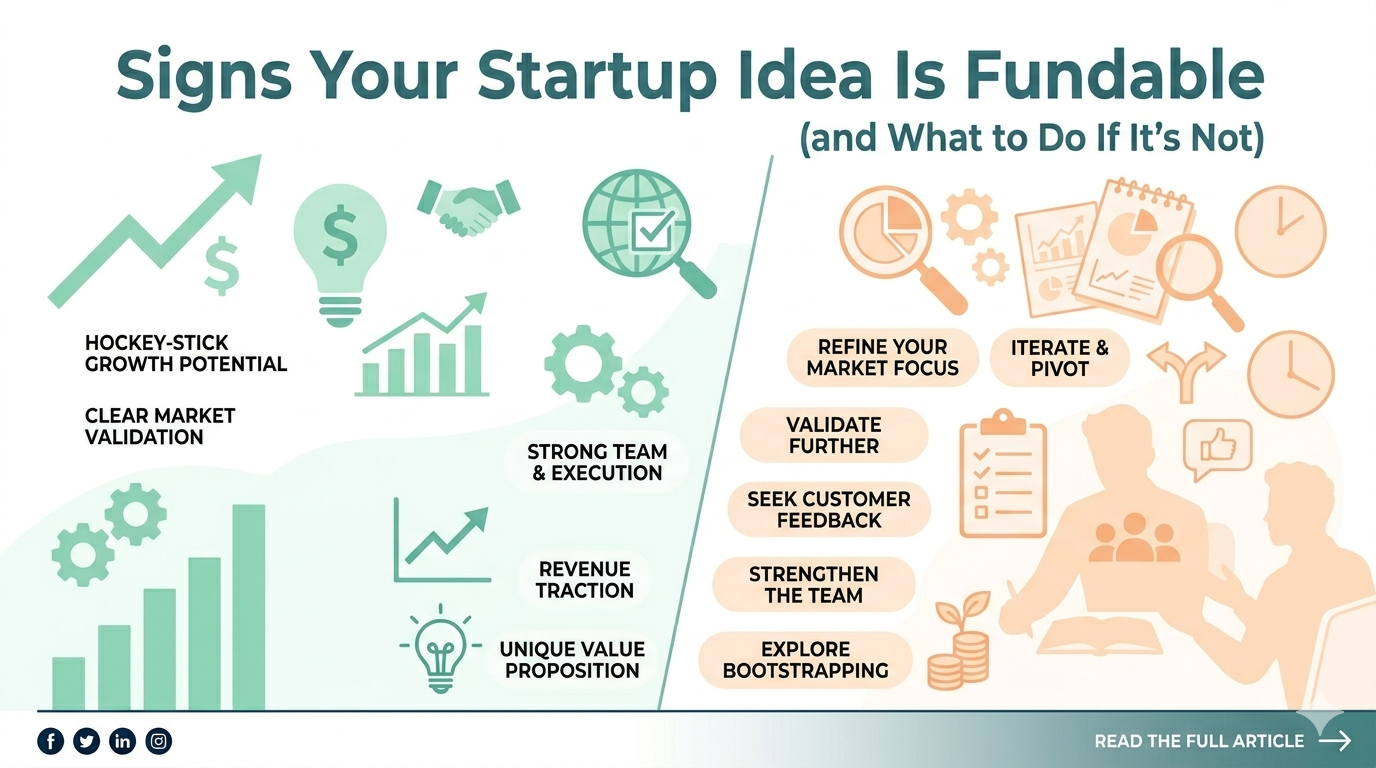
A fundable startup isn’t simply a good idea with enthusiastic founders. Investors — whether angels, seed funds, or venture capital firms — are looking for a specific profile: a large and growing market, a product or service that demonstrably solves a painful problem, early evidence that customers want it, a team capable of scaling it, and a financial model that shows a believable path to returns.
“We don’t expect a complex financial model at this stage, but we do like to see that you’ve thought about: ‘How far will this money get me, and how much more money might I need in the future?’”
The bar also shifts with the funding stage. At pre-seed and seed, investors lean heavily on founder potential and early signals of product-market fit. By Series A, they expect recurring revenue growth, defensible metrics, and an expansion plan. Knowing which stage you’re targeting changes what “fundable” looks like for your startup right now.
8 signs your startup idea is fundable
01
You’re solving a real, painful problem — not just a nice-to-have
The clearest fundability signal is that customers feel genuine pain without your solution. Investors want to see that the problem is urgent, frequent, and that the people experiencing it are willing to pay to solve it. A “me too” product rarely attracts capital unless it has an exceptional execution edge. Investors ask: do customers reach for your product, or do they need convincing it matters?
02
Your total addressable market is large enough to matter
Venture capital math requires big outcomes. Most VC firms are looking for startups with the potential to become $1 billion+ companies — not because every investment will get there, but because the returns from those that do need to cover the losses from those that don’t. If you’re targeting a niche market with a ceiling of $50 million, VC is likely the wrong tool. You’ll need to show credible research on market size and a bottoms-up argument for how you capture a meaningful share.
03
You have early traction — any kind of traction
Traction is proof that the business works in the real world before investors place a bet. This doesn’t have to be revenue. It might be waitlist signups, pilot customers, letters of intent, active users, strong retention, or even a compelling number of conversations where potential buyers said “I would pay for this today.” What it cannot be is zero. In 2025, investors expect to see measurable product metrics earlier than ever in conversations.
04
You’ve achieved (or are clearly close to) product-market fit
Product-market fit means a defined customer segment pulls your product toward them, rather than you pushing it at them. The metrics that signal this include low churn rates, high net promoter scores, organic word-of-mouth growth, and users who are visibly upset at the idea of losing access to your product. For SaaS startups in 2025, early-stage companies targeting ARR growth above 80–100% annually tend to draw the most interest from seed and pre-seed investors.
05
Your founding team has genuine domain expertise
Investor conversations happen quickly, and founders who deeply understand the space they’re operating in make it obvious within minutes. What investors call “founder-market fit” — the sense that this team is uniquely positioned to solve this problem — is one of the most powerful intangible signals. A team with relevant industry experience, prior domain success, or personal connection to the problem has a significant edge over generalist teams building in an unfamiliar space.
06
Your business model is clear and believable
A fundable startup can articulate exactly how it makes money, who pays, how much, and what the unit economics look like over time. Investors don’t expect precise forecasts from pre-revenue startups, but they do expect founders to have thought through customer acquisition costs, lifetime value, and gross margin structure. Startups with monthly recurring revenue growth above 15% are reportedly twice as likely to close Series A rounds in 2025.
07
Your solution is defensible — you have (or can build) a moat
Easily replicated solutions with no barrier to entry are rarely fundable. Investors want to know what stops a well-funded competitor from copying your product in six months. A moat might come from proprietary technology, a network effect, exclusive data, switching costs, brand, or regulatory approval. AI-focused investors in 2025 are particularly focused on “defensible data moats” and evidence of genuine model lift that can’t be reverse-engineered quickly.
08
You’ve found the right investor — not just any investor
Fundability isn’t universal. A startup perfectly positioned for a B2B SaaS seed fund will be ignored by a consumer fintech VC. Every firm has a defined investment thesis covering sector, stage, geography, and check size. A strong pitch to the wrong investor is still a no. Matching your startup to investors whose mandate genuinely includes your category dramatically improves your success rate.
The fundability self-checklist
- My target customer experiences the problem at least weekly
- I can demonstrate that customers have already paid (or strongly committed to pay) for the solution
- My total addressable market exceeds $1 billion
- I can name at least 10 real users / paying customers who would be very upset if my product disappeared
- My team has at least one person with deep domain expertise
- I have a clear, believable revenue model with realistic unit economics
- I know what my moat is and can explain it in one sentence
- I’ve researched the investors I’m approaching and they fit my stage and sector
Warning signs your idea isn’t fundable yet
No one has paid or committed to pay. If you haven’t found a single person willing to hand over money or sign an LOI, that’s a signal, not a coincidence. It means you either haven’t found the right customer, or the problem isn’t painful enough to warrant spending.
You’re building for a market that doesn’t exist yet. Markets that require years of behaviour change before they can generate revenue are deeply unattractive at early stages. Investors are funding execution risk, not market creation risk on top of it.
Your competitive advantage is “we have better UX.” Better UX alone is not defensible. Larger players can replicate good design quickly. Unless UX is built on a structural advantage (proprietary data, workflow lock-in, etc.), it doesn’t constitute a moat.
Your financial projections are implausible. Hockey-stick projections without a clearly articulated growth mechanism are an immediate red flag. Unrealistic IPO expectations in a small market sector compound the problem.
The market is too small or too crowded. Either extreme creates problems. A market too small won’t generate the returns VCs need. A market so crowded that your differentiation is unclear signals a commoditised play without a durable edge.
What to do if your startup isn’t VC-fundable right now
VC funding is one path, not the only path. The vast majority of successful businesses were never venture-backed. If your idea doesn’t fit the VC profile today, that’s a decision point — not a full stop. Here are the most viable alternatives.
Angel investors
Individual investors move faster and accept more risk at earlier stages than most VC firms.
Equity crowdfunding
Platforms like Wefunder and Republic raised a combined $447M+ in H1 2025 alone.
Equity crowdfunding
Platforms like Wefunder and Republic raised a combined $447M+ in H1 2025 alone.
Accelerators
Programs like YC, Techstars, and sector-specific cohorts offer capital plus credibility.
Revenue-based financing
Non-dilutive capital tied to recurring revenue. Ideal for SaaS and eCommerce founders.
Grants & public funding
Government and sector-specific grants offer non-dilutive capital, especially in healthtech and cleantech.
Founders who pivoted their business model in response to market feedback raised 30% more capital on average in 2025 — a clear signal that iteration, not stubbornness, is what moves ideas toward fundability.
How to make your startup more fundable: a practical path
1. Validate relentlessly before pitching
Talk to 50 potential customers before you write a single line of code. The goal is to find the most painful version of the problem and the customer segment most willing to pay to solve it today.
2. Build a “proof packet”
Investors report conducting an average of 118 hours of due diligence across 83 days per deal. Pre-answering their key questions — market research, financial model, customer evidence, competitive landscape — dramatically accelerates the process and signals professionalism.
3. Focus on one metric that proves demand
Whether it’s weekly active users, MoM revenue growth, or net revenue retention, pick the metric that most clearly proves demand and optimise toward it before your first investor meeting. Investors trust learning loops more than confident storytelling.
4. Build traction before raising
Airbnb had $200 in weekly revenue when it was close to failing in 2009. The team that created momentum with limited resources and documented before-and-after experiment metrics went on to build one of the most valuable companies in history. Scrappiness under constraint predicts scaling discipline later.
5. Match your outreach to the right stage and investor type
Research an investor’s portfolio, check size, and investment thesis before reaching out. Approaching investors whose mandate clearly excludes your stage or sector wastes everyone’s time. A warm introduction from a mutual connection still carries enormous weight in 2025 — network credibility dramatically improves your chances at a first meeting.
6. Consider non-VC paths as a feature, not a fallback
Revenue-based financing, grants, angel rounds, and community crowdfunding all allow founders to extend runway while preserving equity for the right investor at the right time. The best outcome isn’t always the highest headline valuation — it’s the combination of realistic runway, investor alignment, and terms that preserve operational control.
The 2026 funding landscape: what’s changed
Global venture capital more than doubled from $128.6 billion in Q4 2025 to a record $330.9 billion in Q1 2026, but the headline masks a stark reality: deal volume fell to its lowest level since late 2016, continuing a pattern where fewer, larger bets define the market. Investors are not more generous — they are more concentrated.
Just four companies — OpenAI, Anthropic, xAI, and Waymo — captured nearly 65% of all global venture investment in the quarter. AI’s share of total VC jumped from 55% in Q1 2025 to 81% in Q1 2026, and unlike the cloud and mobile eras, this wave is funding physical infrastructure: chips, data centres, autonomous vehicles, and robotics — not just software. For founders in SaaS, fintech, and healthtech, the bar for differentiation has never been higher.
Seed-stage deal count fell 31%, even as total seed dollars rose 30% — meaning fewer startups are getting funded at larger check sizes. The market doesn’t reward being fundable; it rewards being undeniable.
On the alternative side, investment crowdfunding crossed $924 million in 2025 — a record — but Reg CF offering count dropped 29%, and the median raise sat at just $194,000. Equity crowdfunding remains a real channel for founders outside the VC mould, but it now belongs to operators with built-in audiences, not first-timers running passive campaigns.
Fundability is not a fixed attribute of an idea. It’s a function of timing, evidence, team, market, and investor fit — all of which you can influence. The founders who succeed in raising capital are rarely those with the most elegant ideas; they’re the ones who accumulated the clearest evidence, iterated fastest on feedback, and found the investors whose thesis made their startup an obvious yes.
If your idea isn’t fundable today, that’s a diagnosis — use it as a roadmap. And if VC funding isn’t the right vehicle for your business model, the alternatives in 2025 are broader, faster, and more founder-friendly than they’ve ever been.
Ready to stress-test your startup idea?
Use the checklist above as a starting point, then work backwards from the gaps. Every signal you strengthen increases both your fundability and your probability of building something that lasts.