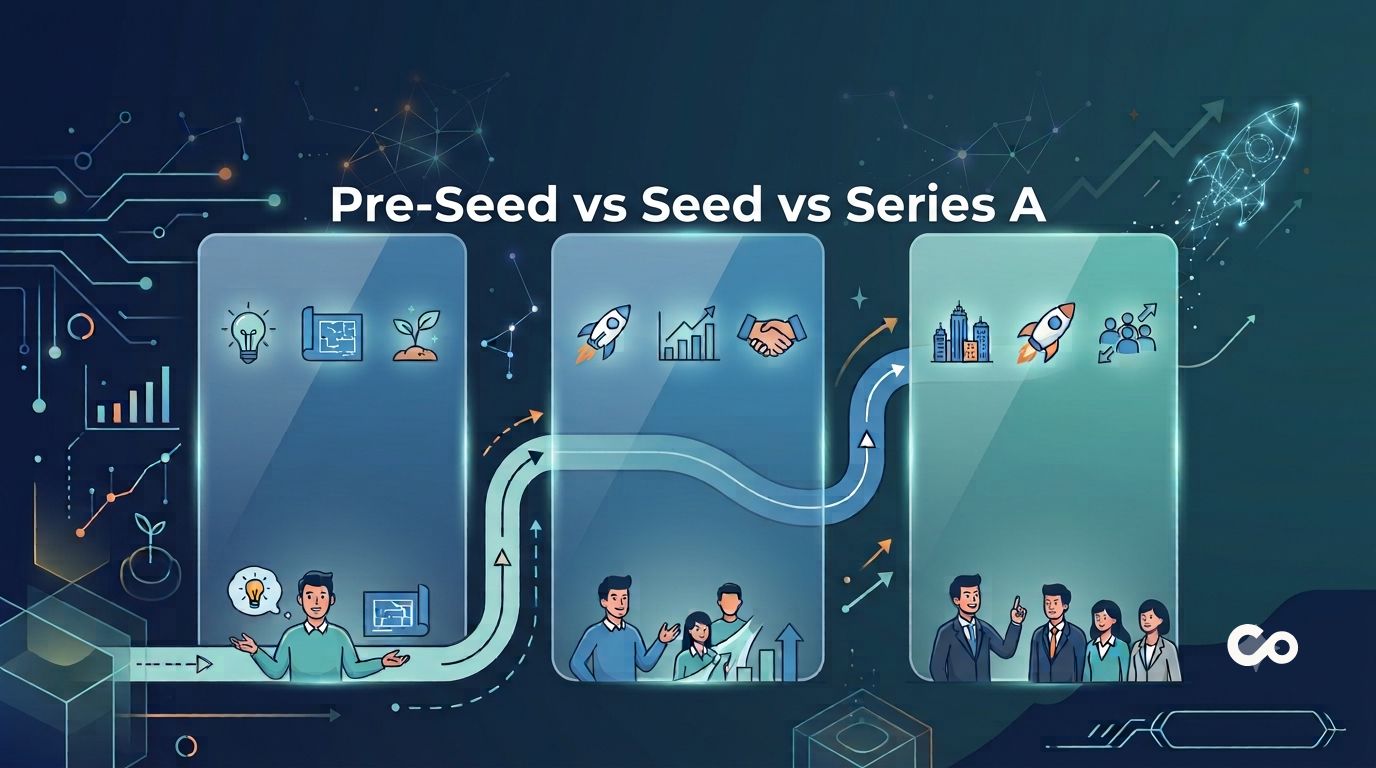
Pre-seed, seed, and Series A are the three earliest stages of startup funding, each defined by how much a company raises, how much proof it has, and what investors expect to see. Pre-seed funds an idea and a founding team; seed funds early traction; Series A funds a business model that’s ready to scale. Knowing which stage you’re actually in changes everything about how you raise.
Quick Comparison: Funding Stages at a Glance
| Attribute | Pre-Seed | Seed | Series A |
| Typical Raise | $50K–$500K | $500K–$3M | $3M–$15M |
| Typical Valuation | $1M–$5M | $5M–$15M | $15M–$50M |
| Stage of Business | Idea to early MVP | MVP with early traction | Proven model, ready to scale |
| Who Invests | Angels, friends & family, pre-seed VCs | Seed VCs, angel syndicates | Institutional VCs |
| What Investors Focus On | Founder quality, problem clarity | Traction, retention, growth signals | Repeatable growth, unit economics |
| Key Documents Needed | Pitch deck, one-pager | Deck, financial model, data room | Deck, full financials, board materials |
Pre-Seed: What It Is and What Investors Expect
Pre-seed is the earliest formal round most startups raise — typically between $50,000 and $500,000, often before there’s a finished product. At this stage, you’re not selling traction, because you usually don’t have much yet. You’re selling conviction: that you understand the problem better than almost anyone, that you’re the right person (or team) to solve it, and that there’s early evidence the problem is real.
Pre-seed checks tend to come from angel investors, friends and family, and a growing category of dedicated pre-seed funds. What these investors look for isn’t a perfect product — it’s founder quality and problem clarity. Can you explain the problem in one sentence? Have you talked to real potential customers? Is there any early signal — a waitlist, a handful of paying pilot users, a strong founder-market fit — that this isn’t just a hunch?
This is exactly where CoStrivv works with founders most: turning a raw idea into a positioning and a story sharp enough that a pre-seed investor can see the opportunity in the first two minutes of a conversation.
Seed Stage: Building on Proof
Seed rounds are larger — typically $500,000 to $3 million — and the bar moves from “this could work” to “this is starting to work.” By seed, investors expect some real evidence: usage numbers, early revenue, retention data, or a rapidly growing waitlist. The story is less about the founder’s conviction alone and more about what the market has already told you.
What changes from pre-seed to seed is the weight of evidence versus narrative. You’ll still need a strong story — investors are still betting on people — but now they’re pairing that story with a financial model, a clearer go-to-market motion, and answers to harder questions: What’s your customer acquisition cost? What does retention look like after 30, 60, 90 days? Is there a repeatable pattern in how customers are finding you?
Series A: A Different Game Entirely
Series A rounds, usually $3 million to $15 million, are a different game — and mostly outside the world CoStrivv’s pre-seed and idea-stage founders are operating in day to day. By Series A, investors expect a proven, repeatable business model: predictable unit economics, a clear path to scaling revenue, and a management team that can execute against an aggressive growth plan. The diligence is deeper, the board expectations are heavier, and the documentation needs to hold up under institutional scrutiny. If you’re pre-seed or early seed right now, Series A is worth understanding conceptually, but it shouldn’t be where your energy goes yet.
Which Stage Are You At? (A Simple Self-Check)
You’re likely pre-seed if:
- You have an idea and possibly a rough prototype, but no meaningful revenue
- You’ve talked to fewer than 20–30 potential customers
- You don’t yet have a repeatable way people find or buy from you
You’re likely seed-ready if:
- You have a working product with real users or early paying customers
- You can point to retention, usage growth, or revenue trending in the right direction
- You have a working hypothesis about your go-to-market channel, even if it’s not fully scaled
You’re likely Series A-ready if:
- You have consistent, predictable revenue growth over multiple quarters
- Your unit economics work, or the path to them is well understood
- You need capital specifically to scale something that’s already proven, not to find it
What Investors Expect at Each Stage
- Pre-seed: Clarity of problem, founder-market fit, early demand signals, a coherent story
- Seed: Usage or revenue traction, a testable go-to-market motion, a credible financial model
- Series A: Repeatable growth, strong unit economics, a scalable operating plan and team
Common Mistakes by Stage
- Pre-seed founders often skip validation and pitch a fully-built vision before testing whether the problem is real, or they undersell their own founder-market fit.
- Seed-stage founders frequently confuse activity (sign-ups, downloads) with real traction (retention, revenue, repeat usage), which investors see through quickly.
- Series A founders sometimes raise too early, before unit economics are proven, which sets an unrealistic bar for every round that follows.
Frequently Asked Questions
Can you raise pre-seed without a product? Yes. Many pre-seed rounds close on a strong founding team, a clear problem, and early validation signals like customer interviews or a waitlist — a finished product isn’t required, though a rough prototype helps.
What’s the difference between pre-seed and a friends & family round? A friends & family round is often the informal capital that funds a pre-seed stage — money from personal networks rather than professional investors. Pre-seed can include friends and family, but it also often involves angel investors and dedicated pre-seed funds with more structured terms.
How long does pre-seed fundraising take? Most pre-seed rounds take 2–4 months from first investor conversation to close, though it can move faster with warm introductions and a tight, well-prepared pitch.
Do I need a pitch deck for pre-seed? Yes — even a short, 8-to-10 slide deck. It doesn’t need heavy financials, but it does need a clear problem, solution, market size, and team slide to guide the conversation.
What’s a SAFE note? A SAFE (Simple Agreement for Future Equity) is a common pre-seed and seed funding instrument that lets investors provide capital now in exchange for equity later, once a priced round happens — without setting a valuation upfront.
Ready to Know Exactly Where You Stand?
Understanding which stage you’re in is the easy part — being ready for it is the harder one. [link: Investor Readiness Guide] walks through exactly what to prepare before you start raising, and CoStrivv’s Startup Strategy and Roadmap Service can help you build the model investors will actually ask for. Or download the free Investor Readiness Checklist to see exactly where the gaps are before your first investor conversation.